
From Barking to Balance: How Unmet Needs Can Show Up at Home
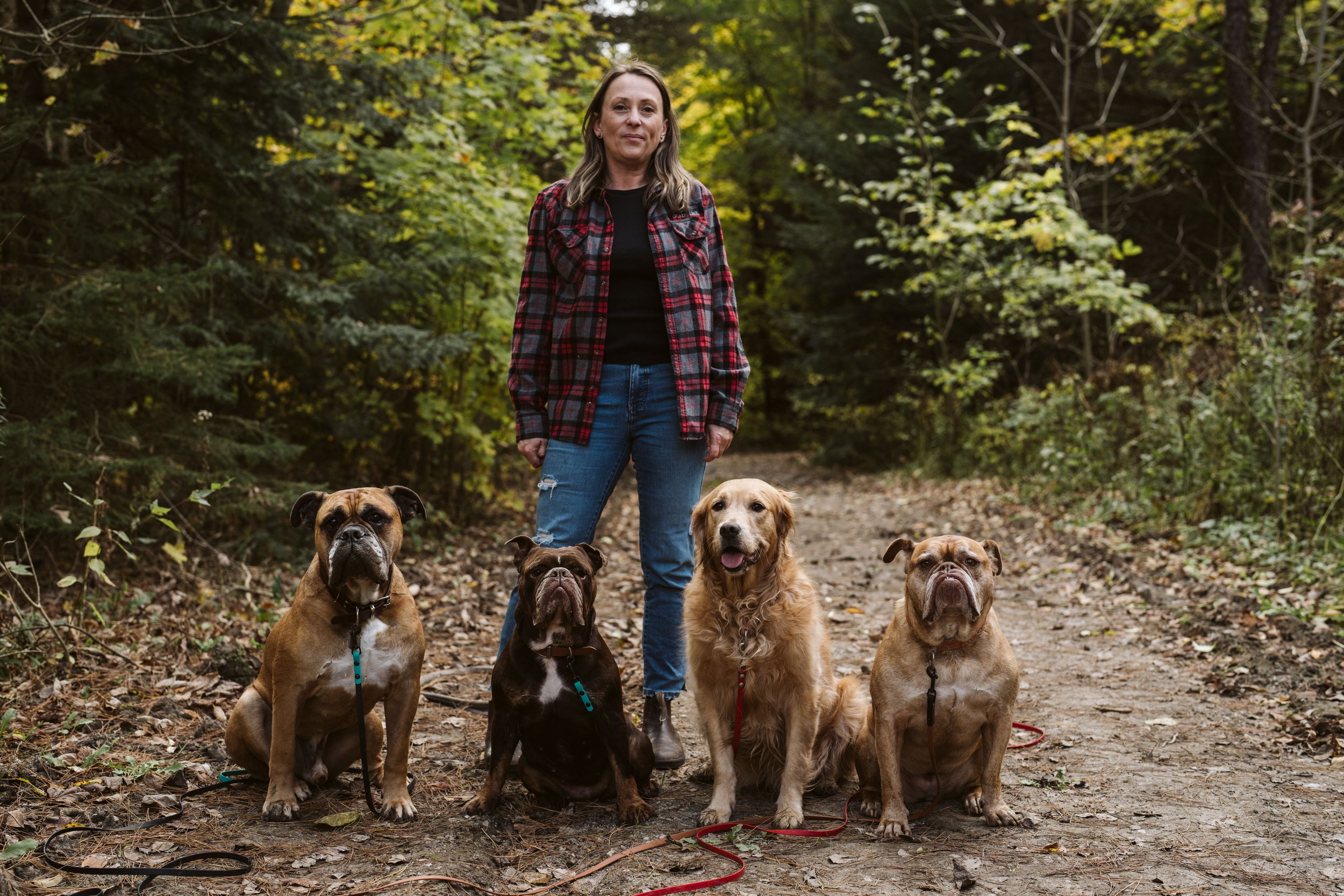
After spending more time just watching how each of my dogs naturally spends their day, I started to notice clear patterns — who was relaxed, who was restless, and who always seemed to need “something.”
It didn’t take long to realise that the differences weren’t random. Each dog was doing what made sense for them — and that showed me exactly what was missing for the others.
Different Dogs, Different Needs
On a typical day, whether it’s morning or afternoon, I take my laptop out to the deck to get some work done, and the dogs are invited to join me.
When we’re outside, it’s easy to see how differently each of my dogs spends their time.
Hazel is the busiest of the group. Most of her time is spent foraging, tracking, and hunting — rummaging through the leaves, sniffing along the fence line, checking the woodpile for chipmunks, or following the chickens around. When she’s not exploring, she checks in with me or settles down for a rest. Sometimes she’ll bring me a toy or ball; other times, she just wants a moment of connection — a few pets, a head scratch, or quiet companionship.
Lucy splits her time more evenly between activity and rest. She loves to forage and hunt for snakes and chipmunks, but she’s also a keen observer — listening, watching, and scenting the air to detect threats or gather information. She might dig a little or even eat some dirt before eventually choosing to rest or come over for social time.
Hank alternates between resting and asking to go inside (and back out again) 10,000 times— seeking comfort, solitude, or sometimes a bit of attention from me.spends some of his time on patrol. He marks, listens, watches, and scents the air, taking in information about his surroundings. He forages and tracks a bit, but not nearly as much as Hazel or Lucy.
Ella has very little interest in exploring the yard. She spends very little time foraging or gathering information and prefers to rest or wander in and out of the house. to look for comfort or find something to do when she’s bored.
The shift
By late afternoon, the differences between them become even clearer. Every single day, around three or four o’clock, Ella ramps up her campaign for attention by pawing at me, pacing and maybe even some whining. The others stay fairly chill, especially Hazel and Lucy, who’ve already spent most of the day satisfying their natural needs.
Fast forward to the evening. It’s about eight p.m., and I’m ready to park myself on the couch. Hazel and Lucy are happy to each grab a bone or chew, find a comfortable spot, and relax.
Hank and Ella, on the other hand, can’t settle. They pace, invade my personal space, or — in Hank’s case — bark at me, and Ella whines.
These behaviours — barking, pacing, whining, attention-seeking — are annoying but to the dog, they’re functional. They exist because at some point, they worked. They got our attention. They produced a response.
The dogs who are able to meet their own needs show far fewer of these nuisance behaviours — and that’s not a coincidence. Those little patterns of behaviour tell me something is missing — or not.
Walks
And that’s exactly what’s happening here. Hazel and Lucy spent their day engaging in healthy dog activities — foraging, tracking, exploring, resting — so by evening, they’re content. But for Hank and Ella, the backyard is far less enriching.
This is where walks come in. Hank’s not a forager like Hazel or Lucy. He needs to check out what’s happening beyond the fence — to mark, to gather information about who and what has been moving around the neighbourhood. He also needs off-leash time to move freely, and get the exercise he needs.
Ella needs movement and novelty. She wants to see things happen — frogs hopping, cars passing, maybe a boat or two. And fun fact: she also prefers to poop away from home, likely because her sore leg and arthritic knee make her feel a bit vulnerable when she’s close to everyone else.
The days when Hank gets a hike and some training time, and Ella gets her frog hunts — everyone is on the couch by 8 and in bed by 9. Including me.
The wrap up
It’s easy to label barking or pestering as “bad,” but behaviour itself isn’t good or bad — it’s just information. When we take emotion and frustration out of it and look at what the dog is trying to tell us, we can respond proactively instead of reactively.
So, if you find yourself frustrated with your dog’s behaviour, ask yourself:
What might this behaviour be telling me? What need might be going unmet right now?
The more we help our dogs meet their natural needs in healthy, appropriate ways, the fewer “problems” we see, and the more calm and quiet we find in our homes. It’s smart management and good welfare.