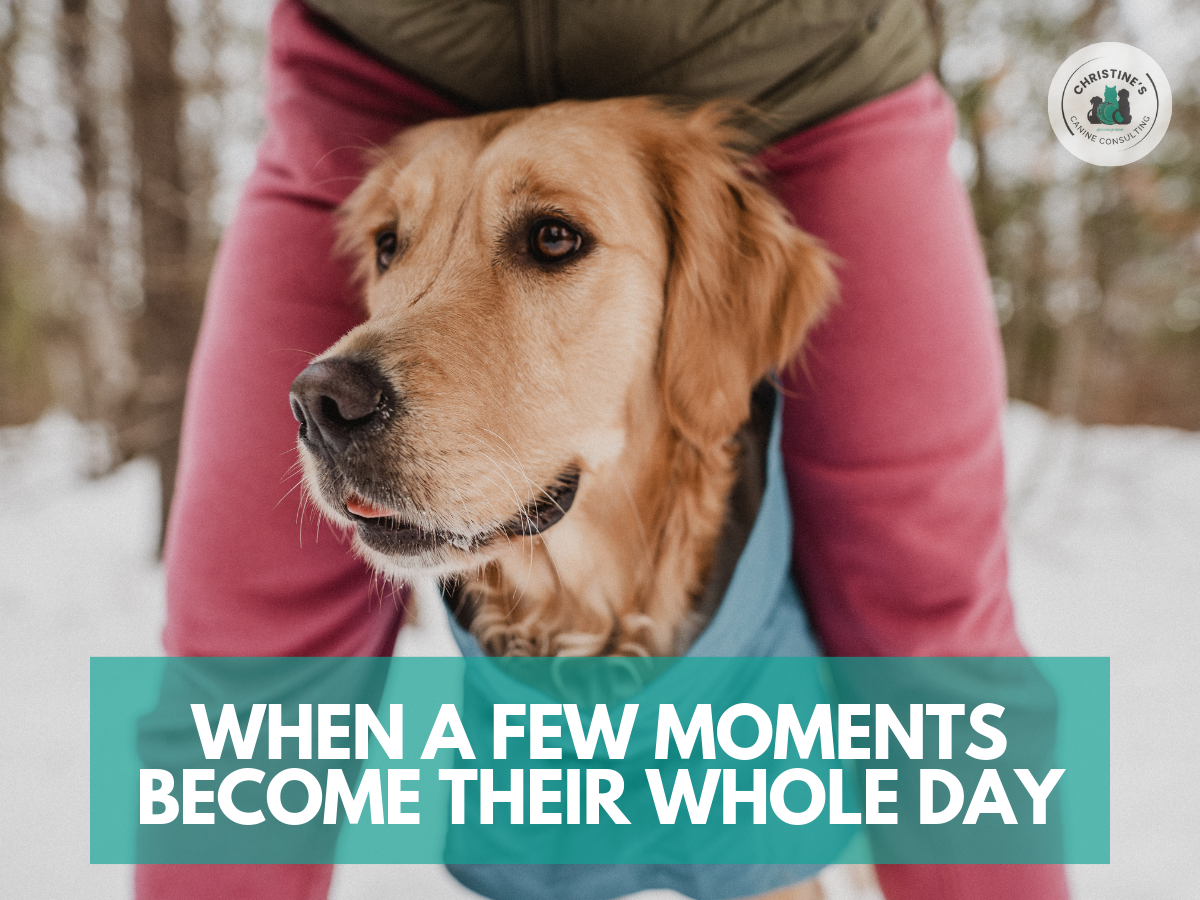
When a Few Moments Become Their Whole Day
“I just want my dog to stop the nipping or barking on pulling on walks. Why are we talking about this enrichment stuff?”
Because we have to. No matter what behaviour or training concerns you have, we have to start by looking at your dog’s overall well-being.
The Day to Day
If you were seeing a doctor or psychologist for your own health, they wouldn’t jump straight to treatment. They would start by asking you questions — what you’re eating and drinking, how much and what type of exercise you’re getting, how well you’re sleeping, and what your day-to-day life actually looks like.
We know these things shape a person’s physical, mental, and emotional health — and the same applies to dogs.
Dogs need nutritious food, appropriate and varied exercise, good rest and sleep. But what’s often overlooked is what a dog is actually doing all day.
Dogs need stimulation — sensory and mental stimulation. They’re wired to scavenge, forage, sniff, chase, grab, and make deep social connections.
In many homes, a dog’s day is fairly quiet and predictable. Opportunities to do those things are limited.
That is until it’s time to go out into the yard. Someone comes through the door. It’s walk time, dinner time or play time.
Those moments take on extra significance and become disproportionately important.
The Fallout
Imagine your dog’s needs as a jug of water. That jug needs to be emptied every day.
Each activity or event your dog experiences represents one glass.
If you only have two or three glasses to pour all that water into, they’re going to overflow.
And you’re going to have a mess on your hands.
That overflow often shows up as behaviours like:
Seek stimulation from the people in the house— jumping, barking, mouthing, nipping, pawing, humping.
Massive excitement when someone comes home and difficulty settling once they do.
When food comes out, dogs hang around in the kitchen, counter-surfing, scavenging or putting paws up for a better sniff.
When it’s time for their meal, the anticipation and excitement leads to jumping, spinning or scarfing down their food the second it hits the floor.
Seeking stimulation from the yard — constantly wanting to go outside, or not wanting to come back in at all.
Watching out the window for someone, something, anything to bark at.
Chaos leaving the house — just getting the leash on is an ordeal.
Frantic pulling, hyper-focus, barking or lunging on walks.
Many dogs struggle to settle before or after these transition times — not because they lack training, but because those moments are carrying too much of the day.
Puppies and Adolescents
This is often where it starts.
Young dogs are going through significant physical, neurological, and hormonal changes. They’re still figuring out how the world works.
They’re driven to investigate.
To move.
To explore.
To interact.
To test boundaries.
To gather information.
They’re not being bad, stubborn, or trying to dominate you — their need for stimulation outpaces their ability to regulate their emotions.
But it’s not just puppies and teenage dogs who struggle.
Any dog living in a restricted or highly predictable environment can start to funnel most of their emotional energy into a handful of daily moments.
Enrichment Enters The Chat
Offering dogs appropriate outlets that encourage natural behaviours every day helps regulate the intensity that often fuels the behaviours we’re trying to change.
Sniffing opportunities that tap directly into natural foraging and scavenging behaviour.
Exploration of new and novel items or locations.
Problem-solving projects and training games.
Chewing, digging shredding and licking.
Meaningful social time with people or other animals.
When a dog’s day includes more enrichment — more glasses to pour their energy into —
Walks are still something to look forward to.
Food is still interesting.
People coming home is still exciting.
But these few events don’t have to hold all the water.
When it comes to training, obedience, compliance and control might make us feel better — but they won’t solve behavioural problems like barking, jumping, nipping or destruction on their own.
In fact, chasing those things without looking at the bigger picture can make the problems worse.
Some food for thought.
Dogs don’t just need to listen better, do less, or “calm down.”
They need to be understood.
Their needs need to be respected.
And their training plan needs to take those needs into account.
You might be surprised to find that when your dog has more appropriate opportunities to simply be a dog, less training is required in the first place.